Atomizer
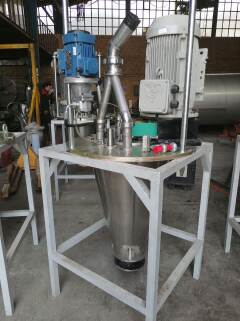
Type Of Atomizers
:Droplet production process in a rotary atomizer
In a rotary atomizer, droplet production is based on centrifugal force. In this way, the concentrated fluid (concentrate or slurry, etc.) is injected into the center of a rotating disk with uniform pressure, speed, and flow rate. After passing through the defined path (and based on a specific mechanism for each product), this fluid is transferred to the disk environment and spread on the disk environment. Then, it is converted into very fine droplets under centrifugal force. The process of converting the fluid into a drop is very important.
Because initially, the fluid must be converted into a uniform thin film and then converted into fine droplets by breaking the molecular bond. A very important and key point in an atomizer is the compatibility of the disk with the type of product. Therefore, a unique disk must be used for each product. The centrifugal force required to break the molecular bond is different for each product. Therefore, in addition to the geometric shape and dimensions of the disk, the rotational speed is of second importance
:Rotary atomizer rotation speed
Since the basis of this type of atomizer is based on centrifugal force, a very high rotation speed must be created for it. Kian Afzar Company's rotary atomizers are designed and manufactured in the range of 7000 to 18000 revolutions per minute (rpm) with different disk diameters from 120 to 450 mm
:Rotary atomizer application
Pharmaceutical industries: Production and mixing of pharmaceutical powders, production of licorice powder, production of food supplements, production of veterinary drugs, genetics, etc
Food industries: Production of milk powder, whey powder, instant coffee powder, colored whey powder, tomato powder, egg powder
Environmental industries: Separation of solid suspended particles in factory effluents that cause environmental damage. After separation, these particles gain added value and can be reused in various industries Including starch factory effluent
Chemical industries: For the production of various mineral fertilizers including humic acid, amino acid, phosphate fertilizer, etc
?Why is a rotary atomizer used
This type of atomizer is used for high production capacities because it covers a wide range of materials, especially materials with high viscosity (up to 20,000 centipoise)
The initial cost is much lower than the nozzle type
They have higher efficiency
They have lower energy consumption
The useful life of the device is very long
The cost of repairs is reasonable and affordable
Most importantly, the experts of Kian Afzar Company are always and everywhere supporting and accompanying you
Types of rotary atomizer models and their applications
1
PL140
This type of atomizer is actually the smallest type of rotary atomizer produced by this company......
2
KF10
This type of atomizer is semi-industrial and is designed for a capacity of 50 to 170 liters per hour and up to......
3
KF35
In the past, when the spray dryer industry in Iran was used for dairy products including milk and whey, this model of atomizer.........
4
KH35
Another type of model is the KF35, whose height and geometric shape have been changed. The reason for this change is the design of the air distributor and........
5
KH62
The capacity of this atomizer, which is known by this name, is 2000 liters per hour and is known as a two-ton atomizer and is the second generation of spray dryers available in the country.
6
KF75
After the spray dryer industry, especially in dairy products, moved towards higher capacities, this atomizer model was unveiled and launched by this company.......
7
KF100
This model is designed to achieve higher capacities of up to 6000 liters per hour and even higher......
8
KFS
This model is actually a custom atomizer model for cases where the geometry and dimensions of the atomizer do not match the company's routine models.
9
KNZ
In this model, there is no more rotation, and the spraying is done by nozzles and high-pressure pumps that are passed into special nozzles...